


Why Adaptive Cruise Control Is Becoming the Most Important Everyday Tech Feature?
June 16, 2026
In this Article:
● Adaptive Cruise Control (ACC) is shifting from a “premium add-on” to a core commuting tool in modern vehicles.
● It reduces driver workload in stop-and-go traffic by automatically managing speed and following distance.
● Real-world studies show ACC can smooth traffic flow and reduce abrupt braking behavior.
● Newer systems are increasingly integrated with mapping and sensor fusion for better anticipation of road conditions.
● For many drivers, ACC now delivers more day-to-day value than infotainment upgrades or styling packages.
Estimated Reading Time: 12 minutes┃Post by: Jordan Calloway
Adaptive Cruise Control has quietly moved from novelty to necessity in modern commuting environments. What used to be a highway-only convenience feature is now embedded into the daily driving experience of millions of commuters dealing with dense traffic, unpredictable merging behavior, and long idle periods. In practice, ACC has become one of the few driver-assistance systems that consistently reduces cognitive load without requiring behavioral adaptation from the driver.
In congested urban corridors like Chicago’s I-90/94 expressways or suburban arterial highways during peak hours, drivers spend a disproportionate amount of time performing repetitive micro-decisions: braking lightly, accelerating back to speed, adjusting following distance, and reacting to sudden lane intrusions. ACC directly targets this pattern by automating longitudinal control—arguably the most fatigue-inducing aspect of commuting.
Modern evaluations of ACC systems show that their performance is no longer limited to simple “follow the car ahead” logic. Advanced implementations now integrate radar, camera fusion, and increasingly map-based anticipation, allowing smoother deceleration profiles and improved detection of stationary or slow-moving obstacles at higher speeds.
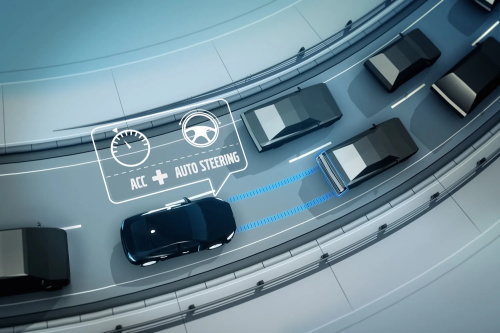
This evolution is critical because it transforms ACC from a reactive tool into a semi-predictive system.
The Real Problem ACC Solves: Cognitive Fatigue in Commuting
Most drivers underestimate how mentally expensive highway driving actually is. Even when physical effort is minimal, the brain is continuously processing:
● Relative speed changes of surrounding vehicles
● Gap distance maintenance
● Brake-light cascades ahead
● Lane-change prediction of adjacent vehicles
● Micro-adjustments to throttle and braking
During heavy congestion, these inputs compound into what traffic psychologists often refer to as “continuous vigilance fatigue.” This is not fatigue from exertion, but from sustained attention switching.
ACC reduces this load by externalizing the entire longitudinal control loop. Instead of manually managing acceleration and deceleration, the driver shifts to a supervisory role.
In real-world usage data, this translates into fewer high-frequency brake events and smoother speed curves, which is especially important in stop-and-go traffic where human drivers tend to oscillate between over-braking and over-accelerating.
How Modern ACC Actually Works (Beyond the Marketing Layer)
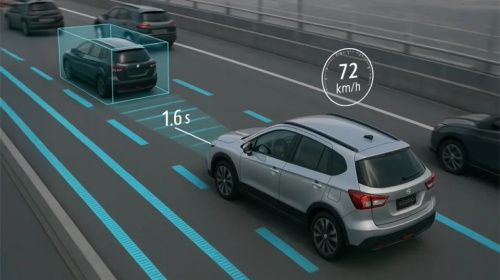
At its core, Adaptive Cruise Control uses a sensor suite (typically radar + forward camera) to maintain a target time gap to a lead vehicle. But modern systems have evolved significantly beyond this baseline.
A simplified breakdown of current-generation ACC behavior:

Recent research highlights that adding map-based anticipation significantly improves safety margins in high-speed scenarios, particularly when encountering stationary vehicles—one of the most challenging edge cases for traditional radar-only systems.
This matters because it addresses a key limitation: humans tend to “see and react,” while improved ACC begins to “predict and prepare.”
Why ACC Matters More in 2026 Than Ever Before
Several macro trends are amplifying the importance of ACC in everyday driving:
1. Traffic density has structurally increased
Urban and suburban corridors are experiencing higher baseline congestion due to hybrid work schedules concentrating travel into narrower peak windows.
2. Vehicle size and weight have increased
Heavier vehicles require more braking distance variability, making consistent human control harder under stress.
3. Driver attention is more fragmented
Modern driving environments include infotainment interaction, navigation input, and smartphone proximity—even when hands-free laws exist.
4. Driving stress is now a measurable cost
Insurance telematics and OEM research increasingly track “harsh braking events” and “speed volatility” as risk factors.
ACC directly reduces all four.
What ACC Feels Like in Real Commuting (Not Theory)
In real-world usage—particularly in dense highway traffic—ACC changes the driving experience in three concrete ways:
Brake-event compression disappears
Instead of 30–50 small braking inputs over a 20-minute congestion segment, ACC compresses behavior into fewer, smoother deceleration cycles.
Following distance becomes consistent
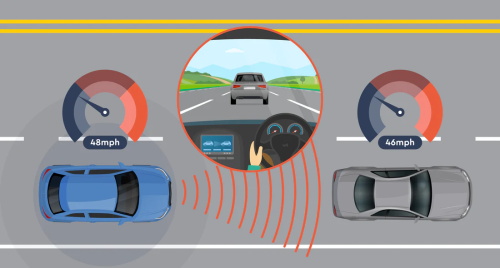
Humans naturally fluctuate gap distance under stress. ACC maintains a stable buffer, reducing collision chain-reaction risk.
“Micro-anticipation fatigue” is removed
Drivers no longer constantly predict whether the lead car will slow unexpectedly. The system absorbs that uncertainty.
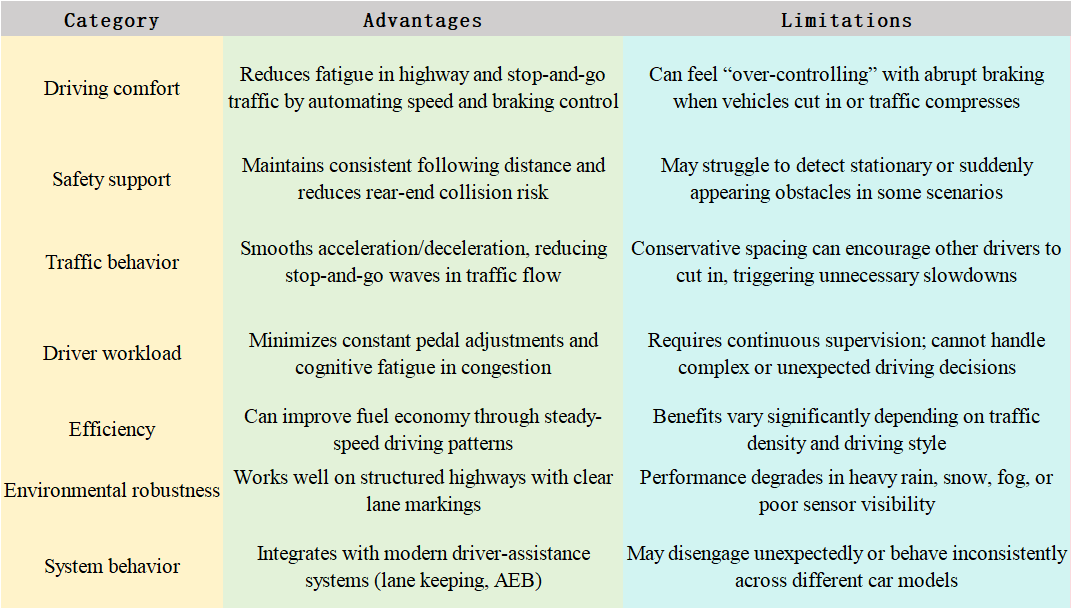
However, it is not flawless. One recurring behavioral limitation observed in real-world driver communities is “cut-in sensitivity.” When another vehicle merges into the gap, ACC may respond with noticeable braking, which some drivers perceive as overly conservative.
This is not a defect so much as a design constraint: the system prioritizes collision avoidance over traffic aggressiveness.
Comparison of Adaptive Cruise Control (ACC): Advantages vs Limitations
ACC vs Other “Modern Car Tech” Features
To understand why ACC stands out, it helps to compare it against other commonly marketed features:
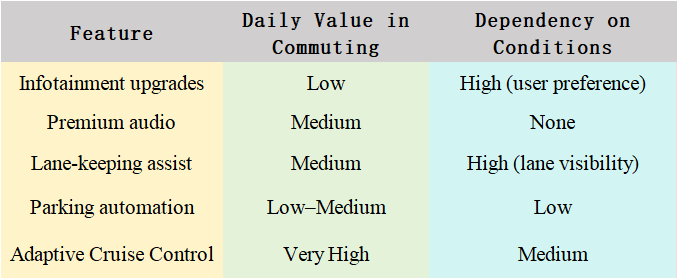
Unlike aesthetic or entertainment features, ACC directly influences the physical driving workload. It changes how the car behaves in the most time-consuming driving scenarios: highway congestion and suburban commuting.
(This article is intended for informational purposes only and does not constitute driving, safety, or purchasing advice. Vehicle technologies vary significantly across manufacturers, model years, and configuration levels. Readers should consult official OEM documentation and conduct test drives to evaluate system behavior under local driving conditions.)
FQAs
1. Does Adaptive Cruise Control work in stop-and-go traffic?
Yes, most modern systems support “stop-and-go” functionality, but some require driver input to resume after a full stop depending on the manufacturer.
2. Is ACC safe in heavy traffic?
ACC is designed to maintain safe following distances, but it is still a Level 1–2 driver-assistance feature, meaning the driver remains responsible for supervision.
3. Does ACC improve fuel efficiency?
In many cases, yes. By reducing aggressive acceleration and braking cycles, ACC can improve efficiency, although results vary based on traffic conditions and driving style.
About Author
Jordan Calloway is an automotive systems analyst specializing in driver-assistance technologies and human-machine interaction in modern vehicles. With a background in transportation engineering and telemetry-based driving research, Jordan focuses on how incremental automation features reshape everyday driving behavior, particularly in congested urban environments.
References
Awathe, A., Patel, D., Mathur, D., & Raut, A. (2026). Enhancing traditional adaptive cruise control through map-based feature integration. SAE International.
Kasubi, F., Mdimi, O. M., & Llorca, A. (2026). Evaluating the impact of adaptive cruise control on freeway merging performance. Journal of Transportation Engineering, 152(5).
Moawad, A., et al. (2024). Effect of adaptive cruise control on fuel consumption in real-world driving conditions. Nature Communications, 15(10016).