



The Science Behind Headrest Positioning and Neck Fatigue
June 18, 2026
Key Takeaways:
● Headrest height and distance strongly influence neck strain during long drives.
● Small misalignments can increase muscle load on the upper cervical spine.
● Proper positioning reduces fatigue by stabilizing head acceleration during vehicle motion.
● Most drivers unknowingly sit with suboptimal head restraint geometry.
● Correct adjustment improves both comfort and crash safety outcomes.
Estimated Reading Time: 12 minutes┃Post by: Dr. Evelyn Hartman
Headrest positioning is one of the most overlooked contributors to neck fatigue in daily driving. Most drivers adjust their seat for legroom and steering comfort, yet leave the head restraint in a default position that is biomechanically inefficient. This mismatch creates a subtle but continuous load on cervical muscles, especially during long commutes or highway travel. Over time, that load manifests as stiffness, soreness, and reduced range of motion in the neck and upper shoulders.
In biomechanical terms, the head restraint is not designed for comfort in normal driving—it is engineered primarily as a safety interface for rear-impact scenarios. However, its geometry directly influences muscle activation patterns even outside of collisions. Research consistently shows that small changes in head-to-restraint distance (“backset”) and vertical alignment significantly alter head-neck kinematics and muscle strain levels during both static and dynamic driving conditions.
Why Headrests Exist: Safety First, Comfort Second
The primary function of a head restraint is to reduce whiplash injury during rear-end collisions by limiting rapid head extension. When a vehicle is struck from behind, the torso is pushed forward by the seat while the head lags behind, creating a dangerous S-shaped curve in the cervical spine.

Properly positioned restraints reduce this differential motion by catching the head earlier in the movement cycle. Crash simulation studies demonstrate that optimized head restraint geometry can significantly reduce cervical extension forces and injury risk.
However, the same forward-biased design that improves crash safety often introduces a subtle forward load during everyday driving. Many modern headrests are positioned with minimal backset (the horizontal gap between head and restraint), meaning the head may rest in a slightly forward-leaning posture even when the driver is relaxed.
The Biomechanics of Neck Fatigue During Driving
Neck fatigue during driving is primarily a result of sustained low-level muscular contraction rather than acute strain. The key muscle groups involved include:
● Sternocleidomastoid (front neck stabilizer)
● Upper trapezius (shoulder-neck interface)
● Deep cervical flexors (postural stabilizers)
When the head is not properly supported, these muscles must continuously counterbalance gravitational torque acting on the skull (which weighs approximately 4.5–5.5 kg in adults). Even a few degrees of forward head tilt can significantly increase this torque.
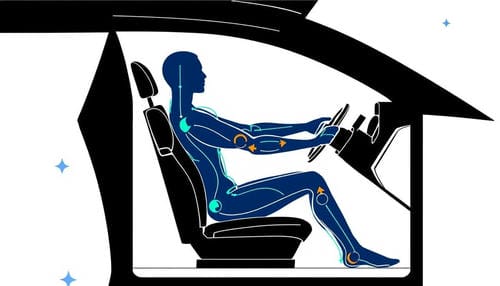
Simplified mechanical interpretation:
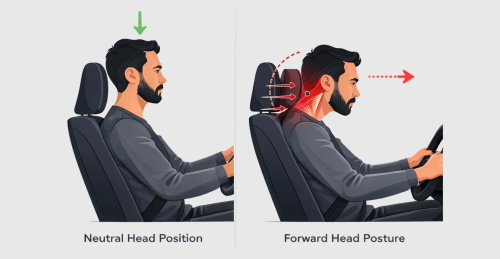
● Neutral head posture → minimal muscle activation
● Forward head posture (common with poor headrest alignment) → increased torque
● Increased torque → sustained muscle activation → fatigue accumulation
This is not a high-force problem; it is a time-under-tension problem. Even mild misalignment, held for 60–120 minutes, can produce noticeable discomfort.
Headrest Position Variables That Matter
There are two primary geometric variables that determine whether a headrest supports or strains the neck:
Vertical Height Alignment
If the headrest is too low, it fails to support the center of mass of the head during rearward motion. If too high, it can create unnatural contact points that encourage forward craning.
Horizontal Backset (Critical Variable)
Backset refers to the distance between the back of the head and the head restraint.

Studies show that increasing backset significantly alters cervical segment motion and increases angular displacement during simulated impacts.
Why Long Drives Make the Problem Worse
On short trips, even poor headrest positioning may go unnoticed. On longer drives, several compounding factors emerge:
1. Micro-vibrations from road surface
Road-induced vibration forces small continuous head corrections. Poor headrest alignment amplifies these corrections.
2. Static posture decay
Humans naturally drift into forward head posture when seated for prolonged periods, especially under cognitive load (navigation, traffic scanning).
3. Seat-back angle interaction
A reclined seat increases the effective horizontal distance to the headrest, worsening backset even if the headrest is technically “correctly” positioned.
4. Fatigue-driven posture collapse
As fatigue increases, deep cervical stabilizers disengage and superficial muscles take over, accelerating discomfort.
Practical Headrest Positioning Protocol (Evidence-Based)
A simple field-adjustable protocol can significantly reduce neck fatigue without compromising safety:
Step 1: Align height
Raise the headrest so the top aligns roughly with the top of your ears or slightly above.
Step 2: Reduce backset
Adjust seat or headrest forward so the gap between head and restraint is minimal (ideally under ~5 cm).
Step 3: Seat-back angle correction
Avoid excessive recline. Maintain a near-upright posture so the headrest is aligned with natural cervical curvature.
Step 4: Test contact
When seated neutrally, your head should lightly contact or nearly contact the headrest without pushing your chin forward.
The Comfort–Safety Tradeoff
One of the most important realities in headrest design is that comfort and crash safety are not perfectly aligned. A more rearward, relaxed position feels comfortable in daily use but increases whiplash risk in rear impacts. Conversely, a closer, more upright configuration improves safety but may feel intrusive at first.
Modern automotive engineering increasingly attempts to reconcile this using adaptive head restraints and active seat systems that move into optimal positions during detected collisions. However, in most consumer vehicles, the driver must still manually balance this tradeoff.
Common Mistakes That Increase Neck Strain
● Leaning forward to “avoid” headrest contact
● Driving with seat reclined too far back
● Lowering headrest below ear level for visibility
● Adding thick cushions that increase backset
● Ignoring posture drift during long drives
Each of these increases the mechanical load on the cervical spine over time.
Why This Matters for Parents and Family Drivers
For parents especially, long drives often involve additional cognitive load: managing children, planning stops, and maintaining situational awareness. Under these conditions, neck fatigue can develop more quickly because postural control is deprioritized by the brain.
Reducing baseline musculoskeletal strain through proper headrest setup can meaningfully improve:
● Driver endurance
● Reaction consistency
● Post-trip recovery comfort
● Overall driving stress levels
(This article is for educational purposes only and does not constitute medical advice. Persistent neck pain, radiating symptoms, or neurological signs should be evaluated by a qualified healthcare professional.)
FAQs
1. Should my head always touch the headrest while driving?
Ideally, your head should be very close to or lightly contacting the headrest in a neutral posture. It should not require you to actively push your head backward.
2. Why does my headrest feel like it pushes my head forward?
Many modern headrests are designed with reduced backset to improve whiplash protection, which can create a forward-biased sensation even when correctly adjusted.
3. Can poor headrest position cause long-term neck problems?
Sustained forward head posture and chronic muscle activation can contribute to cumulative strain, particularly in individuals who drive long distances regularly.
About Author
Dr. Evelyn Hartman is a biomechanics researcher specializing in occupational and vehicular ergonomics. With over a decade of experience studying human–machine interaction in transportation systems, she focuses on reducing musculoskeletal strain in everyday mobility environments and translating crash biomechanics research into practical driver health guidance.
Stay with this blog to explore more practical, science-backed insights that make everyday driving safer, more comfortable, and less physically demanding.