


The New Battle in Car News: Fast Charging vs. Battery Longevity
June 18, 2026
Key Takeaways:
● Fast charging has become a defining feature of modern EV ownership, but it introduces measurable trade-offs in long-term battery health.
● Recent large-scale studies show that frequent ultra-fast charging can accelerate lithium-ion battery degradation under real-world conditions.
● Battery chemistry and thermal management play a larger role in longevity than charging speed alone.
● Manufacturers are increasingly optimizing software to balance charging speed with controlled electrochemical stress.
● EV buyers now face a practical decision between maximum convenience and long-term range retention.
Estimated Reading Time: 11 minutes┃Post by: Elias Hartwell
Fast charging has become one of the most visible selling points in the EV market, but behind the marketing language sits a real engineering trade-off. Charging an EV in 15–25 minutes is no longer science fiction; it is commercially available in many high-end models and expanding across mid-range vehicles. However, multiple recent studies confirm that repeated high-power DC charging can accelerate internal battery wear through mechanisms such as lithium plating and increased thermal stress.
At the same time, the story is not as simple as “fast charging is bad.” Modern battery systems are engineered with sophisticated thermal controls, charge buffering, and adaptive charging curves that reduce damage during high-speed charging events. The real debate in 2026 is not whether fast charging damages batteries—it is how much damage occurs under different conditions, and whether that trade-off is worth the convenience.
Why Fast Charging Changes Battery Chemistry in the First Place
Lithium-ion batteries function by moving lithium ions between the anode and cathode through an electrolyte. Under normal charging conditions, ions intercalate smoothly into the graphite structure of the anode. Fast charging changes the speed of this process dramatically.
When charging power exceeds roughly 100 kW in many EVs, lithium ions are forced into the anode faster than they can safely diffuse into the graphite layers. This imbalance can lead to lithium plating—where metallic lithium deposits form on the anode surface instead of being absorbed properly. Once this happens repeatedly, it reduces usable capacity permanently.
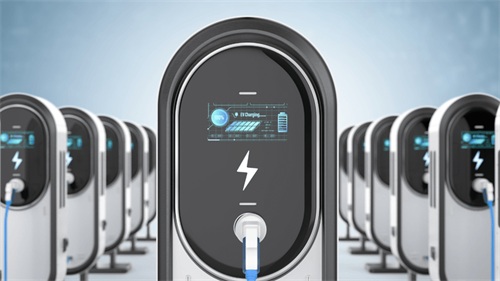
A large-scale fleet analysis of more than 22,000 vehicles found that EVs frequently charged above 100 kW degrade significantly faster than those using slower Level 2 charging, with degradation rates roughly doubling in some usage patterns.
This is not an edge-case laboratory effect—it appears in real-world driving data.
The Real Enemy Isn’t Speed Alone: It’s Heat and Electrochemical Stress
One of the most consistent findings across battery research is that heat is a major driver of degradation. Fast charging inherently increases internal temperature because higher current creates more resistive heating inside the cell.
However, temperature interacts with charging speed in complex ways:
Cold batteries + fast charging → higher risk of lithium plating
Hot batteries + fast charging → accelerated chemical breakdown of electrolyte
Poor thermal management → uneven cell aging across the pack
In practice, EV manufacturers attempt to operate within an “optimal thermal window,” typically between ~20°C and ~40°C. Outside this range, fast charging becomes significantly more stressful on the chemistry.
This is why modern EVs precondition the battery before fast charging sessions—warming or cooling the pack to reduce internal resistance and minimize side reactions.
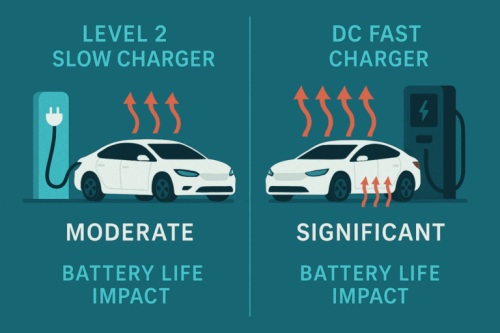
Fast Charging vs. Battery Degradation: What the Data Actually Shows
Research shows that fast charging can increase battery degradation, but the impact depends on charging frequency, battery chemistry, and temperature management. Occasional use has a relatively small effect, while frequent reliance on ultra-fast charging can accelerate capacity loss over time.
Battery type also matters. LFP batteries generally handle frequent charging better than NMC and NCA batteries. For most drivers, occasional fast charging during road trips is unlikely to significantly affect battery life, but daily use may contribute to faster aging over the long term.
What Fast Charging Does to Real-World Range Over Time
A practical way to understand degradation is to translate it into usable range loss.
Most modern EVs experience:
● ~1.5%–2.5% annual capacity loss under mixed charging habits
● Higher loss rates when DC fast charging is frequent
For a vehicle with a 400 km (248 mile) rated range:
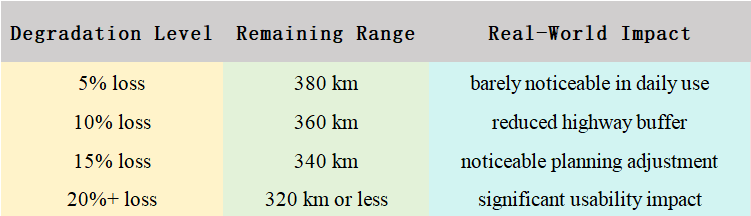
Fleet data suggests that frequent high-power charging can push vehicles toward the upper end of this degradation range earlier in their lifecycle compared to home-charged equivalents.
Why EV Makers Are Still Pushing Faster Charging Anyway
Automakers continue to pursue faster charging because convenience remains a major factor for EV buyers. Shorter charging times help reduce range anxiety and make EV ownership more practical for long-distance travel.
Manufacturers are also improving battery cooling systems, charging software, and battery designs to reduce the negative effects of high-power charging. Their goal is to deliver faster charging without sacrificing long-term battery durability.
What This Means for EV Buyers in 2026
For most EV owners, the best approach is balance. Home charging remains the most battery-friendly option for daily use, while fast charging is ideal for road trips and occasional convenience.
Buyers should consider battery chemistry, thermal management, and warranty coverage in addition to charging speed. By combining sensible charging habits with modern battery technology, owners can enjoy both convenience and long-term battery health.
The Industry Is Not Choosing One Side—It Is Engineering Both
The EV industry is not moving toward eliminating fast charging or prioritizing longevity alone. Instead, it is converging on systems that try to reconcile both objectives simultaneously.
Future improvements—solid-state batteries, lithium-metal anodes, and smarter thermal control algorithms—are explicitly designed to reduce the trade-off between speed and degradation. Early prototypes already demonstrate faster charging with improved lifespan under controlled conditions.
In practical terms, the question is shifting from “Does fast charging damage batteries?” to “Under what conditions does fast charging become effectively neutral?”
That distinction will define the next decade of EV development.
(This article is for informational and educational purposes only and does not constitute technical, financial, or automotive purchasing advice. Battery performance varies significantly by manufacturer, model, environment, and usage behavior. Readers should consult official manufacturer documentation for vehicle-specific guidance.)
FAQs
1. Does fast charging always damage EV batteries?
No. Damage depends on temperature, charging frequency, battery chemistry, and state-of-charge management. Controlled fast charging with proper thermal management has significantly lower impact than uncontrolled high-temperature charging.
2. Is home charging always better for battery life?
Generally yes, because Level 2 AC charging produces less heat and stress. However, occasional fast charging for long trips has minimal long-term impact in most modern EVs.
3. What is the best way to extend EV battery life?
Avoid frequent extreme charge levels, keep charging between ~20%–80% when practical, and use fast charging primarily for travel rather than daily routines.
About Author
Elias Hartwell is an automotive systems analyst specializing in electric powertrains, battery degradation modeling, and charging infrastructure strategy. He has worked with independent mobility research groups analyzing EV fleet data across North America and Europe, with a focus on real-world battery aging behavior under mixed charging conditions.
Stay tuned to this blog for more in-depth breakdowns of EV technology trends, real-world data insights, and practical ownership strategies shaping the future of mobility.