


The Growing Market for ‘Simpler’ Cars With Fewer Digital Features
June 14, 2026
In this Article:
● Many car buyers in 2026 are actively rejecting overly complex infotainment-heavy vehicles.
● Simpler cars reduce long-term ownership costs by limiting electronic and software failure points.
● Drivers increasingly value durability, repairability, and predictable controls over digital convenience.
● Automakers are reintroducing physical buttons and minimal dashboards due to consumer pressure.
● Entry-level, low-feature vehicles are seeing renewed demand despite industry tech expansion.
Estimated Reading Time: 12 minutes┃Post by: Caleb Morganstone
In 2026, something unusual is happening in the automotive market: after more than a decade of relentless digital expansion, a growing segment of buyers is deliberately stepping backward. Not toward outdated technology, but toward intentional simplicity. Cars with fewer screens, fewer software layers, fewer subscriptions, and fewer “smart” systems are quietly gaining traction among cost-conscious, reliability-focused, and even tech-fatigued consumers.
What was once dismissed as “base trim economy driving” is being reframed as a rational response to escalating ownership complexity. The modern car, increasingly defined by software, touch interfaces, and connected services, has created a parallel demand for vehicles that behave more like durable mechanical tools than rolling computers.
This shift is not theoretical. It is visible in sales patterns, product planning strategies, and regulatory nudges across major automotive markets.
Complexity Fatigue Has Become a Measurable Market Force
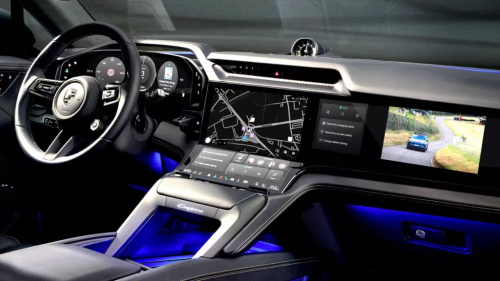
The average 2026 vehicle is no longer just a mechanical system; it is a networked computing environment on wheels. Central touchscreens control climate systems, driving modes, infotainment, and sometimes even safety features. While this integration improves capability, it has also introduced friction.

Drivers report that routine actions—adjusting temperature, changing radio settings, or disabling alerts—now require navigating nested menus instead of using instinctive physical controls. Studies and industry commentary increasingly describe this as “complexity fatigue,” where the cognitive load of interacting with a vehicle becomes part of the driving burden itself.
This fatigue is not just psychological. It is operational. Drivers must re-learn interfaces after software updates, deal with lagging systems, and adapt to inconsistent UI logic across brands. In practice, this reduces the perceived reliability of the vehicle, even when mechanical reliability remains strong.
A key data point emerging from consumer surveys in 2026 shows that a significant portion of drivers actively perceive modern in-car technology as excessive and distracting. The result is a paradox: cars are objectively more capable than ever, yet many users feel less in control of them.
Simpler Cars Reduce Long-Term Ownership Risk
One of the strongest drivers behind the “simplification” trend is not ideology—it is cost predictability.
Modern vehicles concentrate a large number of functions into interconnected electronic systems. While this reduces manufacturing complexity, it increases repair complexity. A single touchscreen failure can disable climate control, navigation, and media systems simultaneously. Likewise, software glitches can immobilize features unrelated to mechanical drivability.
This creates a new category of ownership cost: electronic risk exposure.
Typical Ownership Comparison (2026 Market Estimates)
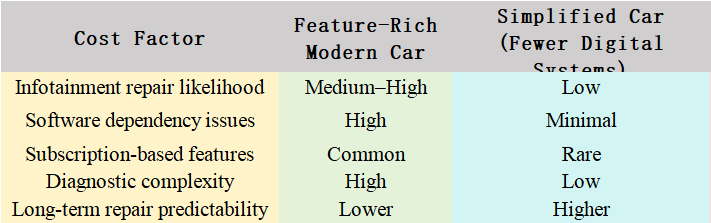
Even when simplified vehicles are not cheaper upfront, their long-term financial profile is easier to forecast. That predictability is becoming a major selling point for buyers concerned about rising repair costs and insurance volatility.
In many cases, buyers are explicitly trading convenience features for reduced exposure to unpredictable electronic failures.
Physical Controls Are Making a Quiet Comeback
The “all-touchscreen” era is beginning to plateau. Regulatory bodies and safety organizations have raised concerns about the time required to complete basic tasks using touch interfaces while driving.
Research cited in automotive safety discussions shows that certain touchscreen interactions can take several seconds longer than physical equivalents, increasing distraction risk. This has led to renewed interest in tactile controls such as knobs, buttons, and switches.
By 2026, this has translated into design changes:
● Climate controls returning to physical knobs
● Dedicated buttons for hazard lights, wipers, and defrost
● Reduced reliance on screen-based menus for critical functions
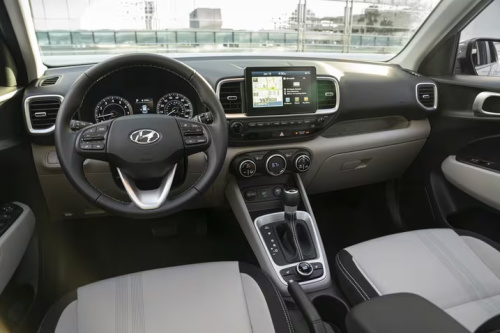
Some safety frameworks are even beginning to incentivize physical interfaces in scoring systems, indirectly pushing manufacturers away from fully screen-dependent interiors.
The implication is subtle but important: simplicity is no longer purely nostalgic—it is increasingly aligned with safety optimization.
Why Automakers Are Quietly Supporting Simpler Trims
At first glance, the industry appears committed to digital expansion. Large screens, connected services, and subscription features remain central to premium branding strategies. However, beneath that layer, manufacturers are also reintroducing simplified trims and stripped-down variants.
There are three structural reasons:
1. Price Sensitivity in Mass Markets
Entry-level buyers are pushing back against vehicles that exceed psychological affordability thresholds. Reports from 2026 indicate increased demand for lower-cost models with fewer optional features, particularly in the $20,000–$30,000 range.
2. Feature Utilization Reality
Consumer behavior data repeatedly shows that many advanced features are underused after purchase. Buyers often rely on a small subset of core functions—driving, navigation via phone, audio, and climate control.
3. Manufacturing and Support Complexity
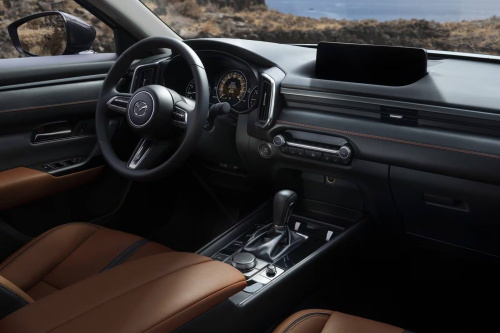
Ironically, simplifying base trims reduces warranty exposure and service variability, even if high-end trims remain complex.
This creates a dual-market strategy: high-tech flagship models for branding, and simplified variants for volume stability.
4. The Rise of “Durability-First” Consumer Psychology
A notable behavioral shift is occurring among buyers: durability is increasingly being treated as a form of luxury.
Rather than associating luxury with screens or automation, some consumers now define it as:
● Fewer points of failure
● Easier repairs
● Longer software stability cycles
● Physical controls that do not change after updates
This mindset aligns closely with broader economic pressure. As vehicle prices rise and monthly payments become more burdensome, consumers are reassessing what constitutes value.
A simplified car is no longer viewed as “less equipped,” but as “less risky.”
Real-World Market Signals of the Simplification Trend
Several observable indicators reinforce the trend:
● Stronger sales performance of entry-level models with minimal digital interfaces
● Increased online search activity for vehicles with physical controls
● Emerging startup EV designs explicitly removing screens and entertainment systems
● Growing consumer discussions about rejecting subscriptions inside vehicles
Even community sentiment reflects this shift. Discussions frequently emphasize the desire for vehicles that prioritize function over software layers, with many users explicitly stating they would prefer fewer features if it meant greater reliability and lower cost of ownership.
The Future: Not Less Technology, But Better-Contained Technology
Importantly, this trend is not a rejection of technology itself. It is a rejection of overexposed technology.
The likely future of automotive design is not a return to 1990s analog vehicles, but rather:
● Hidden complexity (software remains, but is less visible)
● Hybrid interfaces (screens + physical controls)
● Modular feature systems (optional rather than default digital layers)
● Stronger separation between driving-critical and entertainment systems
In other words, technology becomes infrastructure again—not the dominant interface.
The growing demand for simpler cars reflects a broader correction in automotive design philosophy. After years of maximizing features, manufacturers are now being forced to re-evaluate what drivers actually want versus what they are being sold.
For a significant portion of the market, the answer is increasingly clear: fewer systems, fewer dependencies, and fewer surprises. Not because drivers reject progress, but because they are redefining what progress should feel like behind the wheel.
(The information presented in this article is intended for general informational and editorial purposes only. Market trends and consumer behaviors described are based on aggregated industry reporting and public data available at the time of writing. This content does not constitute financial, purchasing, or investment advice. Readers should evaluate vehicle choices based on their own needs, regional availability, and professional consultation where necessary.)
FAQs
1. Are simpler cars less safe than modern high-tech vehicles?
Not necessarily. Many safety systems (airbags, ABS, stability control) remain standard even in simplified trims. The difference is mostly in infotainment and convenience features, not core safety engineering.
2. Why do modern cars have so many screens if people dislike them?
Screens reduce manufacturing complexity and allow automakers to update features via software. They also support subscription-based revenue models, even if some users find them distracting.
3. Will simplified cars become cheaper in the future?
Some models will become more affordable, but regulatory requirements and material costs limit how low prices can go. The main benefit is often long-term ownership stability rather than dramatically lower upfront cost.
About Author
Caleb Morganstone is an automotive analyst and writer specializing in consumer vehicle behavior, mobility economics, and automotive design trends. With a background in transportation systems research, Caleb focuses on how technological change reshapes driver expectations, ownership costs, and vehicle usability in modern markets.
Recommended for you: